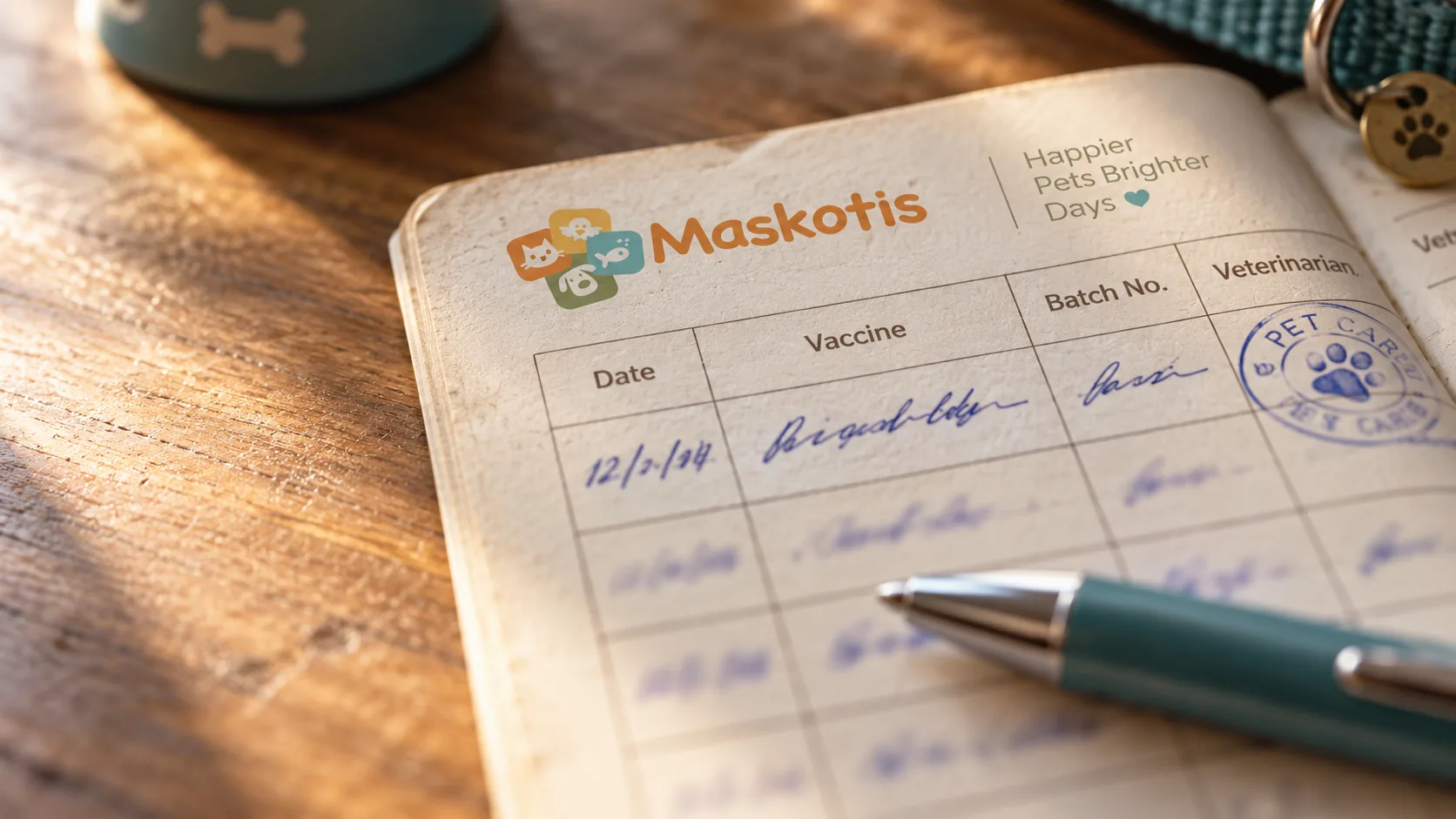
Open your pet's card and look at any line from two years ago.
It's almost always the same: there's a date, there's something written in a fast
hand, and there's a signature. And if someone asked you today what that line
actually says, you couldn't tell them.
That isn't anyone's fault. The line was filled in inside thirty seconds, at a
counter, while your dog was trying to leave. The problem is that the line had to
last for years, and nobody mentioned that while it was being written.
The test for whether a line works
It's one question:
Could someone who wasn't there that day read it and know what happened?
That "someone" might be a new vet, the person looking after your pet while you
travel, your partner, or you in two years — which, practically speaking, is a
different person.
If the answer is no, the line got written but nothing got recorded.
The five parts of a complete line
1. The date, with the year. This is the one that collapses most often. "March
12th" works for a few months and then never works again. The year is what turns a
note into a history.
2. What was given, by its full name. Exactly as they write it, exactly as it
appears on the box or the receipt. Don't summarise it, don't translate it, don't
abbreviate it yourself: one clinic's shorthand doesn't always mean the same thing
at the next one.
3. Who gave it, and where. The name of the person who saw your pet and the
name of the clinic. It looks like padding right up until the day there's a
question and that specific person is the one who can answer it.
4. The next date, as they told it to you. Not the one you worked out, not the
one you read somewhere: the one that came out of the appointment. If you weren't
given one, that's information too — write down that it's still open.
5. Where the proof is. The receipt, the sticker some clinics peel onto the
page, the photo you took. A line with backup is worth twice as much.
Four of the five fill themselves in at the counter. The fourth is the one that
almost never gets written — it's said out loud, heard, and forgotten before you
reach the car.
Two kinds of line that are worth nothing
The one-word line. "Vaccine." "Deworming." No full name, no next date. A year
later it answers no question at all.
The photo with no date. A picture of a receipt, sitting in a camera roll
among four thousand others. It exists, but it can't be searched, can't be sorted,
and can't remind anyone of anything. It's "a little while ago", in JPG form.
When the line comes back incomplete
It happens constantly, and it isn't a problem if you catch it in time: while
you're still at the counter, it can still be fixed.
Three questions, twenty seconds, and nobody minds:
- "Could you write the full name on it, please?"
- "What date should I put for the next one?"
- "Could you sign or stamp this line?"
What you ask there gets resolved. What you ask a year later doesn't.
What they tell you out loud is also a line
This is the biggest leak of all. Every appointment includes things that don't fit
on the card — "this is the first of a series", "bring him in before you travel",
"if it happens again, tell me". None of it gets written down anywhere.
Write it wherever everything else lives, even if that's the back of the page. A
line with no context is a loose date; a line with context is a decision somebody
made for a reason.
And one thing worth being explicit about here: we are not going to tell you
what to give your pet, or how often. That's decided by whoever can examine
them. All we're saying is that what has already been decided should be written
down properly.
What it looks like put together
A well-written line reads like this, and needs no explanation:
2 May 2026 — gave [full name, exactly as written]. Seen by [name], at
[clinic]. Next: [the date they gave]. Receipt photographed. Note: [what
they said out loud].
Six lines. Zero interpretation. Anyone can read it.
Why we're building Maskotis
All of the above can be done in a notebook, and a notebook works. What doesn't
work is the only copy of the history living on a sheet of paper that travels
around in a backpack — which is what
what a digital vaccination card actually is
is about.
Today in Maskotis you can register your pet and keep their care events there, as
these fields rather than as a loose photo. What we're working on is telling you
when the date you were given is coming up; that isn't open yet.
In the meantime, on the next line you write: put the year on it.
Maskotis does not give medical recommendations and this article is not a
substitute for a veterinary consultation. What your pet is given, when, and how
often is decided by the person who can examine them. Take them to the vet you
trust, or to the nearest clinic — they'll help you there.