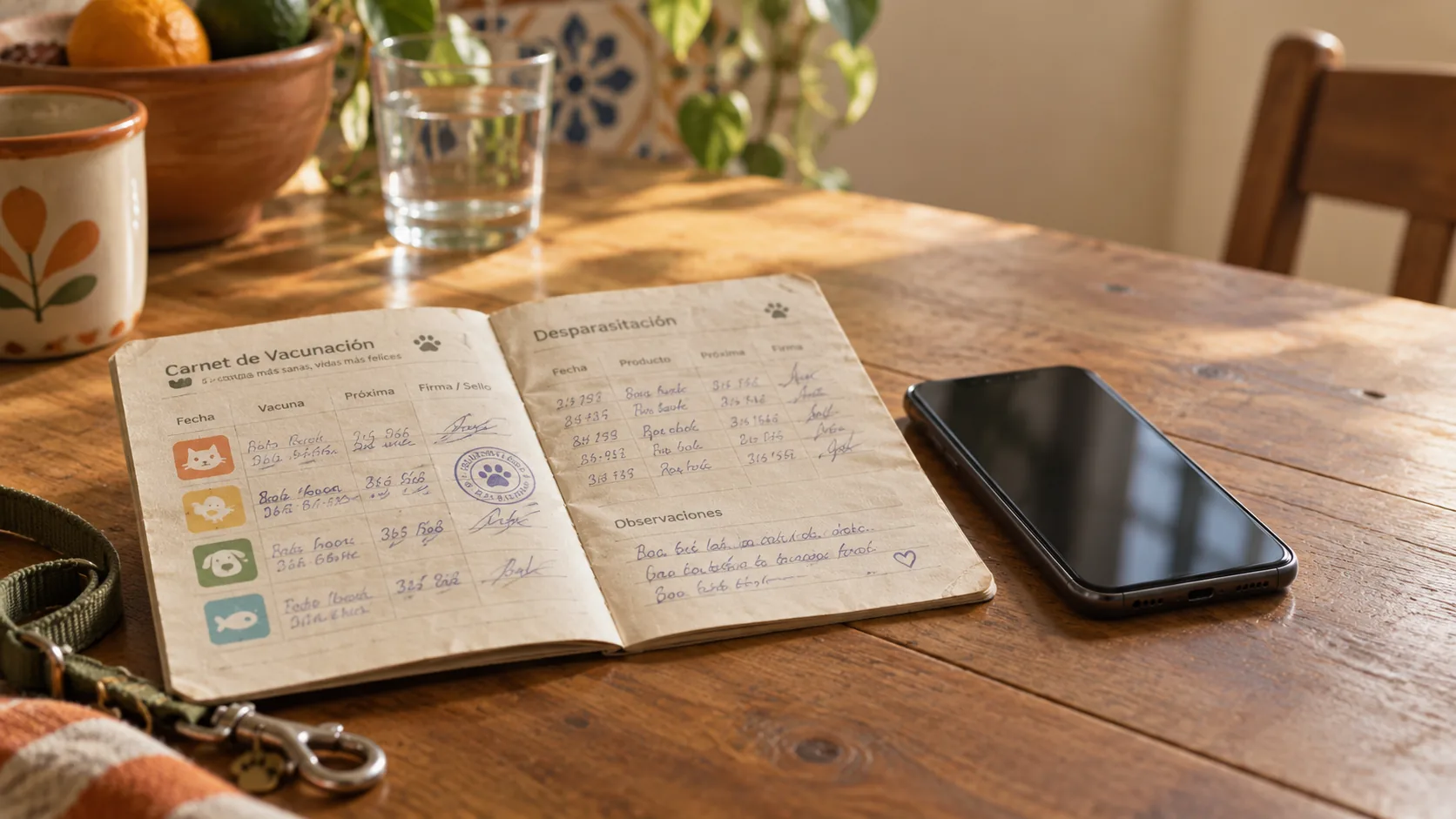
Almost everyone knows what the card is. It's that sheet folded into quarters,
with ruled lines, stamps, and somebody else's handwriting.
What almost nobody knows is where it is.
"In the folder, I think." "The vet gave it to me and then I lost track of it."
"It was in the glovebox of the car we sold." Nobody says this with any guilt, and
nobody should: the paper card was designed for the clinic counter, not to survive
four years in a house where people live.
The paper card works very well, right up until it doesn't
It's worth saying what it does well first, because it does several things well.
Someone else writes it — and that matters: it's the handwriting of the person who
examined your dog, not your memory. It carries a stamp. Counter staff accept it
without argument. It needs no battery, no signal, and no password you have to
remember. It costs nothing.
The problem is a different one, and it's structural: there is exactly one
copy.
One copy that rides around in a backpack, gets rained on, and lives in the
important-papers folder until the folder moves house. And when that copy
disappears, it isn't a sheet of paper that's gone: it's the whole history, because
the paper was the history. There was nowhere else.
So what is a digital card?
It's the same content — the dates, what was given, who administered it, the next
date you were told — kept somewhere that doesn't depend on that sheet of paper
surviving.
That's all. And to earn the name, it has to do three things:
1. Hold the paper card as it is. A photo or a PDF of both sides. The paper is
still the original and the clinic will keep asking for it; the digital version
doesn't replace it, it backs it up.
2. Store dates as dates, not as a photo. This is the real difference between
a digital card and a folder of pictures on your phone. A photo can't be sorted,
searched, counted, or used to remind you of anything. A date written as a date
can.
3. Let the information leave. Show it at the counter, print it when someone
asks for paper, share it with whoever looks after your pet while you're away. A
card you can only see inside one app is half a card.
What a digital card is not
This is where it pays to be blunt, because some apps promise more than they
should.
It is not a vet. It doesn't tell you what to give your pet, how often, or how
much. No app knows your dog's age, where they live, who they live with, or the
climate they're in. The person who can answer that is the one looking at the
animal.
It is not the clinical file. The file — what was observed, what was measured,
what was decided — belongs to the clinic. Your card is the part that's yours:
what was given, when, and when it's next.
It is not a requirement. Nobody is going to demand an app. If you'd rather
use a notebook, a notebook works. The only thing that doesn't work is memory.
Five questions that tell you whether one is worth using
Before you put four years of history inside something, it's worth asking:
- Can I get my data out if I ever want to leave? If the answer is no, it
isn't your history — it's theirs.
- Can I print it? The day will come when the counter wants paper.
- Is it written in my language, by someone who speaks it? You can tell on
the first screen.
- Does it work on the phone I already have? Not the next one.
- What happens if I stop paying? Does the app close, or does the history get
deleted? Those are not the same thing, and the difference matters a lot.
What you can do today, with no app at all
This is free and takes two minutes:
- Find it. Now. Before you finish reading, honestly.
- Photograph both sides, in good light, so the dates are legible.
- Send it to yourself on WhatsApp, or put it in an album you'll still be able
to find in a year.
- Put the next date — the one your vet gave you — in your phone's calendar,
with an alarm.
That is already a digital vaccination card. A crude one, but a real one.
Everything else is convenience stacked on top of those four steps.
Why we're building Maskotis
Maskotis exists because of exactly that gap: a place where your pet's care
history lives, so the next date doesn't depend on your memory or on a piece of
paper that got lost in a move.
Today you can register your pet and keep their care events there. What we're
working on is telling you when the date your vet gave you is coming up, so you
don't have to be the one who remembers — that isn't open yet, and you'll know
when it is.
What Maskotis will not do, even when it's finished, is tell you what to give your
pet. That's decided by whoever can examine them.
In the meantime: photograph the card, today. It takes less time than finishing
this article.
Maskotis does not give medical recommendations and this article is not a
substitute for a veterinary consultation. What your pet is given, when, and how
often is decided by the person who can examine them. Take them to the vet you
trust, or to the nearest clinic — they'll help you there.