Search "pet friendly CDMX" and you'll find twenty lists. Nearly all say the same
thing, hardly any say when the information is from, and several send you to
places that have closed.
The underlying problem is that a list expires and a rule doesn't. If you know
what applies across the whole city, and you know how to ask before you go, you
stop depending on whether someone updated a blog.
This is the second thing.
What applies everywhere in the city, always
The Ley de Protección y Bienestar de los Animales de la Ciudad de México, in
article 4 Bis 1, puts the obligations on the person responsible for the animal.
The four that touch you every time you go out:
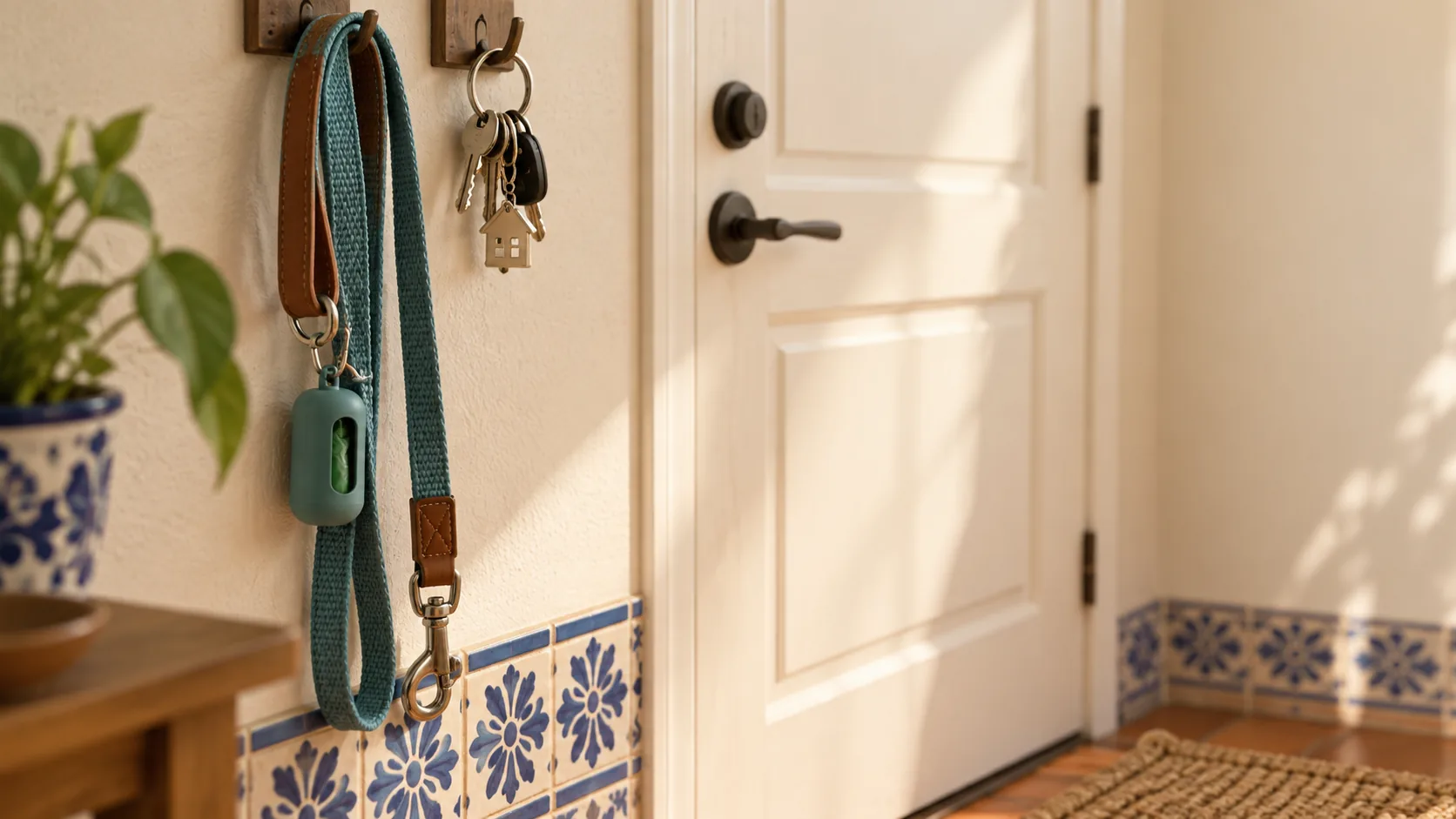
A leash, whenever you're out with them. The text requires keeping the animal
"sujeto con una correa" while in transit, and moving about "sin riesgo para las
personas y otros animales". It applies on public streets, in urban parks and in
Áreas de Valor Ambiental.
Picking up waste. Explicit in the law, with the same three locations: public
streets, urban parks and Áreas de Valor Ambiental. Not a courtesy — an
obligation.
A muzzle in specific cases. The law asks for one "tratándose de perros con
antecedentes de agresión, o poca socialización". That's a description of a
situation, not of a breed.
And the one almost nobody complies with: what the collar has to say. Under
the same article, the collar or harness must carry the animal's name, the RUAC
key, and the contact details of the person responsible.
That third one deserves its own section, because most people walking dogs in this
city have never heard of it.
The RUAC, briefly
The RUAC is Mexico City's single registry of companion animals. The law asks
you to register the animal — directly or during mass campaigns — and for the key
you're given to travel on their collar, along with your phone number.
What it does in practice: it's how a lost animal gets connected back to its home
without depending on someone having your number written down. A tag with a name
and no contact details is decoration. A tag with a name, a key and a phone number
is a route home.
Registration is done on the city's official site — it's in the sources at the
bottom — and it's worth doing before you need it rather than after.
Write the key down wherever the rest of your pet's history lives. It's the
kind of detail that gets asked for, forgotten, and looked up again; and if you
ever have to read it out over the phone in a hurry, you'll be glad it wasn't
buried.
Bosque de Chapultepec, specifically
It's the most-asked-about place in the city and the most confusing, because the
answer is neither yes nor no: it depends on the section.
According to Pro Bosque Chapultepec, which manages the park:
- First Section — most areas don't admit dogs, but there is a Parque
Canino with ramps, play equipment and agility obstacles, on Rubén Darío in
Polanco. Open daily, 8:00 to 18:00.
- Second Section — dogs are allowed in open areas; the Sope area is off
limits.
- Third Section — allowed on trails and green zones, with some restricted
areas.
- Leashed everywhere in the park, always. And you bring the water.
And here's the detail that ruins a lot of Sundays: to enter the Parque Canino
they ask for the RUAC and an up-to-date vaccination and deworming record.
There's also a limit of six dogs per person, no food inside, and no dogs under
four months or animals that are unwell.
As far as we know it's the only public place in the city that will ask for the
card at the gate. Worth bringing — or bringing a photo of it.
How to check any other place before you go
For everything else — cafés, terraces, plazas, hotels — the method beats the
list. Three questions by message or phone, none of which is answered by "we're
pet friendly":
- "Can dogs come in today, or only on the terrace?" An enormous number of
places are pet friendly outdoors only, and the list you saw them on doesn't
say so.
- "Is there a size limit, or do you require a carrier?" It's the restriction
that most often turns up at the door and never in the post.
- "Does it apply every day and at all hours?" Plenty allow dogs on weekdays
but not weekends, or not after a certain hour.
And one rule about sources: believe what the venue publishes, not what a list
publishes. A two-week-old post on the café's own account is worth more than a
two-year-old article with twenty addresses.
What the lists don't tell you
- A map pin that says "pet friendly" isn't a policy, it's a label somebody added
once.
- "Pet friendly" almost never means the same thing at two places: at one it's the
terrace, at another the whole venue, at another "if they're calm".
- Park rules change, and when they change it's announced on the park's site, not
on blogs.
None of this is a reason to stay home. It's a reason to send a message before you
get in the car.
Why we're building Maskotis
At some point half this city will ask you for something written on a piece of
paper you don't have on you: the RUAC key, the date of the last vaccination, the
phone number that belongs on the tag.
Today in Maskotis you can register your pet and keep their details and care
events there, so that paper stops being the only place any of it exists. What a
digital card actually is, we wrote
here, and the eight dates
worth recording are
here.
If you do one thing after reading this: go and look at what your dog's tag
actually says.
Sources
Rules change and so do opening hours. Check the source before you go — we're not
lawyers and this isn't legal advice, it's where it's written down:
- Ley de Protección y Bienestar de los Animales de la Ciudad de México,
article 4 Bis 1. Text in force, published by PAOT.
PDF
- Registro Único de Animales de Compañía (RUAC), Government of Mexico City.
ruac.cdmx.gob.mx
- Pro Bosque Chapultepec — ¿Cómo puedo llevar a mi perro al Bosque de
Chapultepec?
chapultepec.org.mx
- Reglamento para el Uso y Preservación del Bosque de Chapultepec, SEDEMA.
PDF
Maskotis does not give medical recommendations and this article is not a
substitute for a veterinary consultation. Take them to the vet you trust, or to
the nearest clinic — they'll help you there.