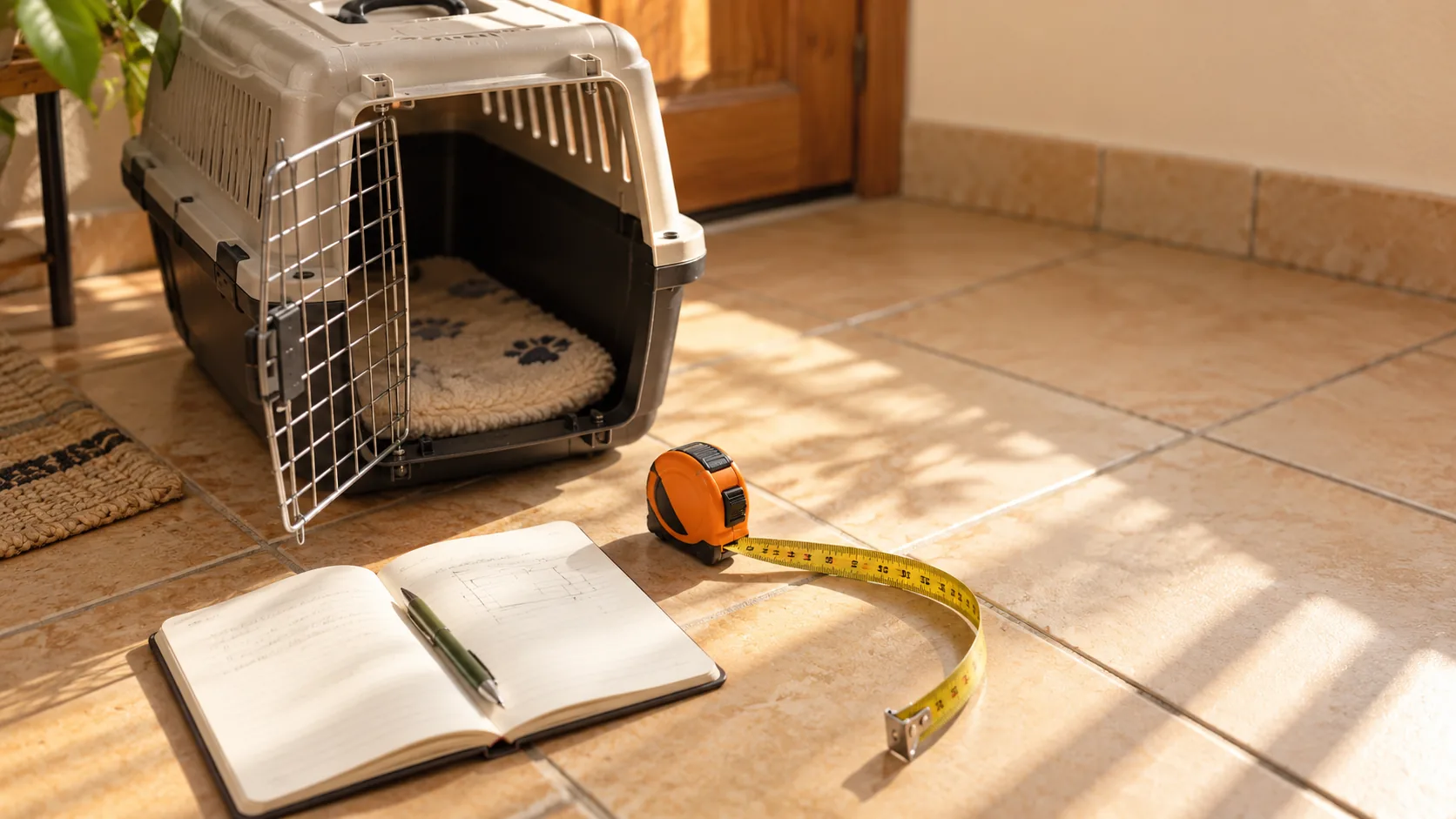
Almost everyone starts in the wrong place: by choosing a carrier.
The right order is the reverse. First you measure the animal. Then you check
what your airline allows. And only at the end do you buy the box — if one exists
that works, which is exactly what you want to find out before spending anything.
Cabin or hold isn't a preference
It's a number, and the number is combined weight: the animal plus its
carrier, together, on the scale.
Every airline sets a cabin ceiling. If your dog plus their box comes in under
that ceiling and the box fits the maximum dimensions, cabin is possible. If
either of those fails, there's no discussion and no counter exception: it's the
hold, a different airline, or a different plan.
For a real reference — the kind we verified in
the article on flying inside Mexico
— Volaris publishes a cabin ceiling of 12 kg combined, with a carrier no
larger than 44 × 30 × 19 cm. Other airlines set other numbers. The shape is
always the same.
How to measure your dog, in five minutes
You need a tape measure, a wall, and someone to help if your dog won't cooperate.
With the animal standing, not sitting or lying down:
A — Length. From the tip of the nose to the base of the tail. Don't
include the whole tail.
B — Height. From the floor to the highest point of the head while standing.
For dogs with upright ears, to the tips of the ears.
C — Width. The widest point of the body, usually the shoulders or the hips.
Write all three down with the date. A puppy changes them in weeks, and six months
from now you won't remember whether they were from before or after.
How those become a box size
Airlines publish similar formulas. Volaris, for instance, describes theirs like
this: the container's length is the animal's length plus a quarter of it,
and the width is double their widest point.
In round numbers, to orient yourself:
- Minimum container length = A + (A ÷ 4)
- Minimum width = C × 2
- Minimum height = B, plus margin so the head doesn't brush the top
That's the smallest box your dog can travel in. It isn't the ideal one: it's
the acceptable minimum, and below it the answer at the counter is no.
The test that settles everything before you buy
You now have two sets of numbers: the minimum your dog needs and the maximum
your airline allows.
If the minimum fits inside the maximum, cabin is possible. Buy a carrier that
lands between the two.
If the minimum is bigger than the maximum, cabin is off the table — and you
know that today, at home, rather than on flight day with the box already bought.
That's the whole exercise. Five minutes and a tape measure save you the most
expensive scene of the trip.
What carrier spec sheets don't tell you properly
- Published dimensions are usually external. Inside is always less, because
of the plastic's thickness and the door. If you're cutting it fine, you'll come
up short.
- Wheels count, and often get in the way. Several airlines require a
wheel-less container for the hold; some accept them being removed. Check
whether yours detach before you buy.
- "Size M" means nothing. Every brand defines it differently. Ignore the
letter and read the centimetres.
- Rigid or soft depends on where they're travelling. For the hold it's almost
always rigid, waterproof and well ventilated. For cabin, soft-sided is usually
accepted and has the advantage of giving a little under the seat — which is
where you'll be asked to make it fit.
Combined weight, in practice
Don't guess. Stand on the scale yourself, then stand on it holding the carrier
with your dog inside, and subtract. It's exact and takes a minute.
Do it with the box you'll actually use, with the blanket and everything else
going inside. That's the number weighed at the airport, not the dog alone.
One last thing, and it isn't paperwork
A new carrier is an unfamiliar box. If they meet it on flight day, they meet it on
the worst possible day.
Open it at home and leave it open weeks in advance, somewhere your dog already
spends time. Let them come and go. Let good, boring things happen in there. It
costs nothing and it's the difference between a box and a place.
Why we're building Maskotis
Your dog's three numbers — length, height, width, with a date — are exactly the
kind of detail that's useful twice and gets lost once: you measure for this trip
and can't find them for the next.
Today in Maskotis you can register your pet and keep their details and care events
there, with dates. What else is worth recording is
here.
Measure today. Buy afterwards.
Each airline's dimensions and ceilings change: confirm them on their official
site before buying a carrier or a ticket. The Volaris examples cited here are
taken from their public page, linked in
the previous article in this series.
Maskotis does not give medical recommendations and this article is not a
substitute for a veterinary consultation. If you have questions about whether
flying suits your pet, that's answered by the person who can examine them. Take
them to the vet you trust, or to the nearest clinic — they'll help you there.